Runtime Entry Path
A step-by-step trace of what happens at runtime when a Nextflow workflow calls Channel.fromBIDS().
Every class name and method call cited here is verified against the actual source code.
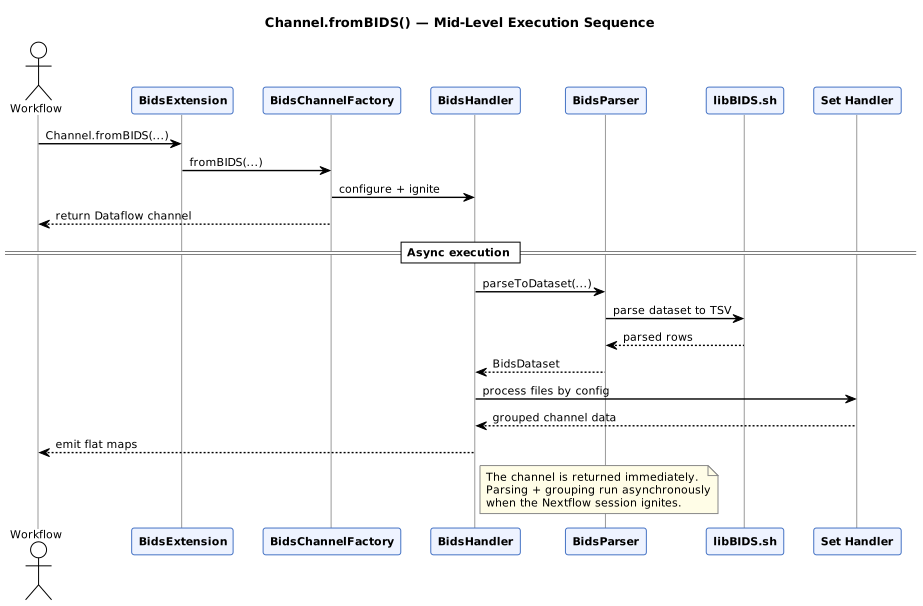
Overview
The execution path spans six layers:
-
Plugin bootstrap — pf4j loads
BidsPlugin; Nextflow bindsBidsExtensionandBidsFactory. -
Channel factory —
BidsExtension.fromBIDS()delegates toBidsChannelFactory. -
Handler assembly —
BidsChannelFactorybuilds aBidsHandlerusing a fluent builder API. -
Async ignition —
BidsHandler.ignite()creates the output channel and schedules asynchronous execution. -
Parsing & grouping —
BidsParser→LibBidsShWrapper→BidsCsvParser, then the set handlers. -
Emission — items flow through
validateAndEmitChannel()onto theDataflowWriteChannel.
Step 1 — Plugin Bootstrap
When Nextflow starts, pf4j scans the plugin JAR for the class declared in the plugin descriptor.
For nf-bids that class is nfneuro.plugin.BidsPlugin, which extends nextflow.plugin.BasePlugin and provides no additional logic.
In parallel, BidsFactory (implementing TraceObserverFactory) is discovered and its create(Session) method is called, registering a BidsObserver with the Nextflow trace system.
BidsObserver prints a startup banner on onFlowCreate and a completion message on onFlowComplete; it carries no domain logic.
Nextflow also discovers BidsExtension (extending PluginExtensionPoint) and calls its init(Session) method, storing the Session reference.
This is the moment when fromBIDS, groupTupleBy, joinBy, and combineBy become available in workflow scripts.
See Plugin Bootstrap for pf4j lifecycle details.
Step 2 — BidsExtension.fromBIDS()
When a workflow script calls Channel.fromBIDS(bidsDir, configPath, options), Nextflow routes the call to the @Factory-annotated fromBIDS method on BidsExtension:
@Factory
DataflowWriteChannel fromBIDS(
    String bidsDir,
    String configPath = null,
    Map options = [:]
) {
    return new BidsChannelFactory(session).fromBIDS(bidsDir, configPath, options)
        as DataflowWriteChannel
}
BidsExtension immediately delegates to BidsChannelFactory, passing the captured Session.
Step 3 — BidsChannelFactory.fromBIDS() and Pre-flight Checks
BidsChannelFactory.fromBIDS() performs three pre-flight validations before touching any BIDS data:
-
Confirms that
bidsDirexists and is a directory. -
If
configPathis non-null, confirms the config file exists. -
If
options.libbids_shis set, confirms that path also exists.
Any failure throws an IllegalArgumentException with a descriptive message, aborting the pipeline before expensive I/O begins.
BIDS dataset validation via BidsValidator is commented out in this release.
The code block exists but is guarded.
BidsValidator.validate() is a stub that logs a warning and returns immediately — full integration is planned for v1.1.
|
After pre-flight, BidsChannelFactory constructs a BidsHandler using a fluent builder:
return new BidsHandler()
    .withConfig(configPath)    // loads + analyzes config
    .withBidsDir(bidsDir)
    .withOpts(options)
    .withParser(new BidsParser(session))
    .ignite(session)
Step 4 — BidsHandler Configuration Loading
withConfig(configPath) calls loadConfiguration(configPath) which:
-
Constructs a
BidsConfigLoaderand callsload(configPath)→ SnakeYAML parses the file, rejects the reserved keymeta, then validates structure viaBidsConfigValidator. -
Calls
SuffixMapper.suffixMapping(config)to build aMap<setType, Map<configKey, actualSuffix>>for heterogeneous configurations that usesuffix_maps_to. -
Constructs a
BidsConfigAnalyzerand callsanalyzeConfiguration(config)→ returns a map of four boolean flags:hasNamedSets,hasSequentialSets,hasMixedSets,hasPlainSets. -
Calls
getLoopOverEntities(config)to extract the list of BIDS entities the channel will iterate over (e.g.,[subject, session]).
If configPath is null, a default empty configuration is used and all set-type flags are false.
Step 5 — BidsHandler.ignite() and Async Execution
ignite(Session) creates the DataflowWriteChannel via CH.create(), then schedules execution:
DataflowWriteChannel ignite(Session session) {
    DataflowWriteChannel target = this.withTarget(CH.create()).target

    if (NF.dsl2) {
        session.addIgniter { -> this.perform(true) }
    } else {
        this.perform(true)
    }

    return target
}
In DSL2 mode (the default since Nextflow 22.x), addIgniter defers execution until the workflow graph is fully assembled.
perform(true) wraps execute() in a CompletableFuture.runAsync so that BIDS parsing runs on a background thread without blocking the Nextflow scheduler.
Exceptions from the background thread are caught in handlerException(), which calls Session.abort() to propagate the error to Nextflow’s error handling layer.
Step 6 — BidsHandler.execute() — Parsing Phase
execute() calls parser.parseToDataset(bidsDir, options.libbids_sh as String).
BidsParser.parseToDataset()
BidsParser is constructed with a Session reference and creates two collaborators:
-
LibBidsShWrapper— the bridge to the external bash parser. -
BidsCsvParser— the TSV reader.
parseToDataset() follows three steps:
def csvFile = libBidsWrapper.parseBidsToTable(bidsDir, libBidsShPath)
def bidsFiles = csvParser.parse(csvFile)
def dataset = new BidsDataset(bidsDir)
bidsFiles.each { file -> dataset.addFile(file) }
dataset.loadParticipants()
LibBidsShWrapper.parseBidsToTable()
This is the most complex step in the chain.
The wrapper must locate the libBIDS.sh script, validate paths against a shell-metacharacter blocklist, and invoke the script safely.
Script Discovery Order
The wrapper follows a strict priority order (first match wins):
| Priority | Location |
|---|---|
1 |
Plugin installation directory: inspects the class URL to find |
2 |
|
3 |
|
4 |
|
5 |
|
6 |
|
7 |
|
8 |
|
9 |
|
If a caller passes options.libbids_sh, that explicit path skips discovery entirely and is validated directly.
If no script is found after all probes, a FileNotFoundException is thrown with actionable suggestions (e.g., run git submodule update --init).
See The libBIDS.sh Dependency for the full discussion of discovery and bundling.
Path Validation and Execution
Before running any command, both the script path and the BIDS directory path are validated against a shell-metacharacter blocklist (;, &, |, $, ` , (, ), <, >, ", ', \, newlines).
This prevents command injection even if a malicious path is supplied.
The command is built in array form to avoid shell string interpolation:
['bash', '-c',
 'set -euo pipefail && source "$1" && libBIDSsh_parse_bids_to_table "$2" > "$3"',
 'bash', scriptPath, bidsDir, outputFile.absolutePath]
The output TSV is written to a temporary file, which BidsCsvParser then reads.
BidsCsvParser.parse()
Reads the TSV header line (columns: derivatives,datatype,subject,template,session,cohort,sample,task,tracksys,acquisition,nucleus,volume,ceagent,tracer,stain,reconstruction,direction,run,modality,echo,flip,inversion,mtransfer,part,processing,hemisphere,space,split,recording,chunk,atlas,segmentation,scale,resolution,density,label,description,suffix,extension,path) and converts each subsequent row into a BidsFile object.
Each BidsFile holds the path, the BIDS suffix, and a list of BidsEntity key-value pairs.
Step 7 — BidsHandler.execute() — Grouping Phase
After parsing, execute() calls two private methods:
DataflowQueue results = processDatasets(
    getBidsParentDir(), bidsFiles, config, configAnalysis, loopOverEntities)

DataflowQueue finalResults = applyCrossModalBroadcasting(
    results, config, loopOverEntities)
processDatasets() — Handler Routing
This method reads the configAnalysis flags and instantiates the matching set handlers:
if (analysis.hasNamedSets)      handlers << new NamedSetHandler()
if (analysis.hasSequentialSets) handlers << new SequentialSetHandler()
if (analysis.hasMixedSets)      handlers << new MixedSetHandler()
if (analysis.hasPlainSets)      handlers << new PlainSetHandler()
Multiple handlers can be active simultaneously for a config file that mixes set types.
Each handler’s process() call receives the same bidsFiles list and loopOverEntities; handlers internally filter to their own suffixes.
Results from all handlers are merged into a single DataflowQueue.
Each handler groups BidsFile objects by the loopOverEntities key tuple, builds BidsChannelData accumulators, and emits [groupingKey, BidsChannelData] entries.
Step 8 — validateAndEmitChannel()
Items from finalResults are consumed one at a time.
If options.flatten_output is true (the default since beta.9), flattenTupleToMap() converts [groupingKey, enrichedData] into:
[meta: [subject: 'sub-01', session: 'ses-01', ...],
 T1w:  [nii: Path('/data/bids/.../sub-01_T1w.nii.gz'), json: Path(...)],
 ...
]
File paths are converted to java.nio.file.Path objects via nextflow.file.FileHelper.asPath(), which handles local files, S3 URIs, GCS URIs, and Azure Blob Storage URIs transparently.
If flatten_output is false, the legacy [groupingKey, enrichedData] tuple is emitted directly.
If options.unpack_json_sidecar is true, .json sidecars are parsed and emitted as maps in either output mode.
After all items are emitted, the channel is closed with target << Channel.STOP.
If zero items were emitted, an IllegalStateException is thrown.
Operator Path — groupTupleBy, joinBy, combineBy
These three operators follow a simpler path and are independent of the BIDS parsing pipeline.
Each @Operator method on BidsExtension validates its closure arguments via KeyExtractor.validateKeyExtractor(), constructs the corresponding *Op object, and calls apply() which returns a new DataflowWriteChannel.
The *Op classes use DataflowHelper.subscribeImpl() to consume the source channel reactively.
KeyExtractor.extractKey() normalises list-valued keys to CompositeKey instances for correct hash-map equality semantics.
Related Pages
-
Source Tree Map — package table and responsibilities
-
The libBIDS.sh Dependency — discovery order and bundling
-
BIDS Parsing — set-type semantics
-
Output Shaping — flat vs. legacy format
-
Channel Operators — operator API reference